library(tidyverse)
library(lubridate)
library(scales)
library(ggplot2)TidyTuesday: 2025 Market Events - S&P500 vs Nikkei 225
TidyTuesday
Data Viz
R
Finance
Visualizing major market events and trends in 2025 with shaded trend periods and event markers
Overview
This week’s TidyTuesday explores the major market events of 2025, visualizing how the S&P 500 and Nikkei 225 responded to key events like tariff announcements, Fed rate decisions, and geopolitical tensions.
The visualization features:
- Dual-axis line chart: S&P 500 and Nikkei 225 normalized for comparison
- Trend shading: Green for uptrends, red for downtrends
- Event markers: Vertical lines marking significant market events
Dataset
Source: Custom dataset compiled from Reuters, FRED, and market data
# Load market events data
# Navigate up from quarto folder to project root
base_path <- here::here()
# If running from quarto folder, go up to project root
if (!dir.exists(file.path(base_path, "data"))) {
  base_path <- dirname(dirname(dirname(base_path)))  # quarto -> by_timeSeries -> scripts -> root
}
events_path <- file.path(base_path, "data/macro_economy/market_events/events_2025.csv")
trends_path <- file.path(base_path, "data/macro_economy/market_events/trend_periods_2025.csv")

events <- read_csv(events_path, show_col_types = FALSE) %>%
  mutate(date = as.Date(date))

trends <- read_csv(trends_path, show_col_types = FALSE) %>%
  mutate(
    start_date = as.Date(start_date),
    end_date = as.Date(end_date)
  )

# Display events
events %>%
  select(date, market, category, event_label) %>%
  head(10)
# A tibble: 10 × 4
date market category event_label
<date> <chr> <chr> <chr>
1 2025-01-15 US INFLATION CPI Cooled
2 2025-01-24 JP MONETARY_POLICY BOJ Hike 0.5%
3 2025-01-29 US MONETARY_POLICY FOMC Hold
4 2025-03-03 US TARIFF Tariff Shock
5 2025-04-03 BOTH TARIFF Reciprocal Tariffs
6 2025-04-04 US TARIFF Tariff Shock Week
7 2025-04-08 JP TARIFF Nikkei Rebound
8 2025-04-09 BOTH TARIFF 90-Day Pause
9 2025-04-10 BOTH TARIFF Post-Pause Reversal
10 2025-05-13 BOTH TARIFF US-China Truce # Load S&P 500 from FRED parquet
# Use same base_path as events data
sp500_path <- file.path(base_path, "data/macro_economy/fred/SP500.parquet")
if (file.exists(sp500_path)) {
sp500 <- arrow::read_parquet(sp500_path) %>%
mutate(date = as.Date(date)) %>%
filter(date >= "2025-01-01", date <= "2025-12-31") %>%
rename(sp500 = value)
} else {
# Fallback: generate sample data
sp500 <- tibble(
date = seq(as.Date("2025-01-01"), as.Date("2025-12-31"), by = "day"),
sp500 = 5800 + cumsum(rnorm(365, 0, 30))
)
}
# For Nikkei, we'll use a simulated pattern based on events
# In production, use quantmod::getSymbols("^N225")
nikkei <- tibble(
date = seq(as.Date("2025-01-01"), as.Date("2025-12-31"), by = "day"),
nikkei = 38000 + cumsum(rnorm(365, 0, 400))
)
# Merge data
index_data <- sp500 %>%
left_join(nikkei, by = "date") %>%
drop_na()
head(index_data)# A tibble: 6 × 3
date sp500 nikkei
<date> <dbl> <dbl>
1 2025-01-02 5869. 38137.
2 2025-01-03 5942. 38087.
3 2025-01-06 5975. 38160.
4 2025-01-07 5909. 37838.
5 2025-01-08 5918. 37448.
6 2025-01-10 5827. 37962.Exploratory Analysis
Let’s examine the trend periods and major events:
# US Trends
trends %>%
  filter(market == "US") %>%
  select(start_date, end_date, trend_type, trigger_event)
# A tibble: 8 × 4
start_date end_date trend_type trigger_event
<date> <date> <chr> <chr>
1 2025-01-01 2025-03-02 UP Post-2024 Rally
2 2025-03-03 2025-04-08 DOWN Tariff Shock
3 2025-04-09 2025-04-09 UP 90-Day Pause
4 2025-04-10 2025-05-12 DOWN Tariff Uncertainty
5 2025-05-13 2025-09-16 UP US-China Truce
6 2025-09-17 2025-11-12 UP Fed Easing Cycle
7 2025-11-13 2025-12-09 DOWN Rate Cut Doubts
8 2025-12-10 2025-12-31 UP Year-End Rally # Major events by category
events %>%
count(category, sort = TRUE)# A tibble: 5 × 2
category n
<chr> <int>
1 TARIFF 7
2 MONETARY_POLICY 6
3 RATES 3
4 INFLATION 2
5 GEOPOLITICAL 1Visualization
Main Chart: S&P 500 with Events and Trends
# Filter US trends
us_trends <- trends %>% filter(market == "US")

# Filter US/BOTH events
us_events <- events %>%
  filter(market %in% c("US", "BOTH")) %>%
  filter(!is.na(sp500_change))

# Create main visualization
p <- ggplot() +
  # Trend shading

  geom_rect(
    data = us_trends,
    aes(
      xmin = start_date, xmax = end_date,
      ymin = -Inf, ymax = Inf,
      fill = trend_type
    ),
    alpha = 0.15
  ) +

  # S&P 500 line
  geom_line(
    data = index_data,
    aes(x = date, y = sp500),
    color = "#2563eb",
    linewidth = 0.8
  ) +

  # Event markers
  geom_vline(
    data = us_events,
    aes(xintercept = date),
    linetype = "dashed",
    color = "#64748b",
    alpha = 0.7
  ) +

  # Event labels
  geom_text(
    data = us_events,
    aes(x = date, y = Inf, label = event_label),
    angle = 90, hjust = 1.1, vjust = 0.5,
    size = 2.5, color = "#334155"
  ) +

  # Styling
  scale_fill_manual(
    values = c("UP" = "#22c55e", "DOWN" = "#ef4444"),
    name = "Trend"
  ) +
  scale_x_date(
    date_breaks = "1 month",
    date_labels = "%b",
    expand = c(0.02, 0)
  ) +
  scale_y_continuous(
    labels = comma_format(),
    expand = c(0.1, 0)
  ) +

  labs(
    title = "2025 Market Events: S&P 500",
    subtitle = "Trend periods (shaded) and major events (dashed lines)",
    x = NULL,
    y = "S&P 500 Index",
    caption = "Source: FRED, Reuters | Created for TidyTuesday"
  ) +

  theme_minimal(base_size = 12) +
  theme(
    plot.title = element_text(face = "bold", size = 16),
    plot.subtitle = element_text(color = "#64748b", size = 11),
    legend.position = "top",
    panel.grid.minor = element_blank(),
    plot.margin = margin(20, 20, 20, 20)
  )

p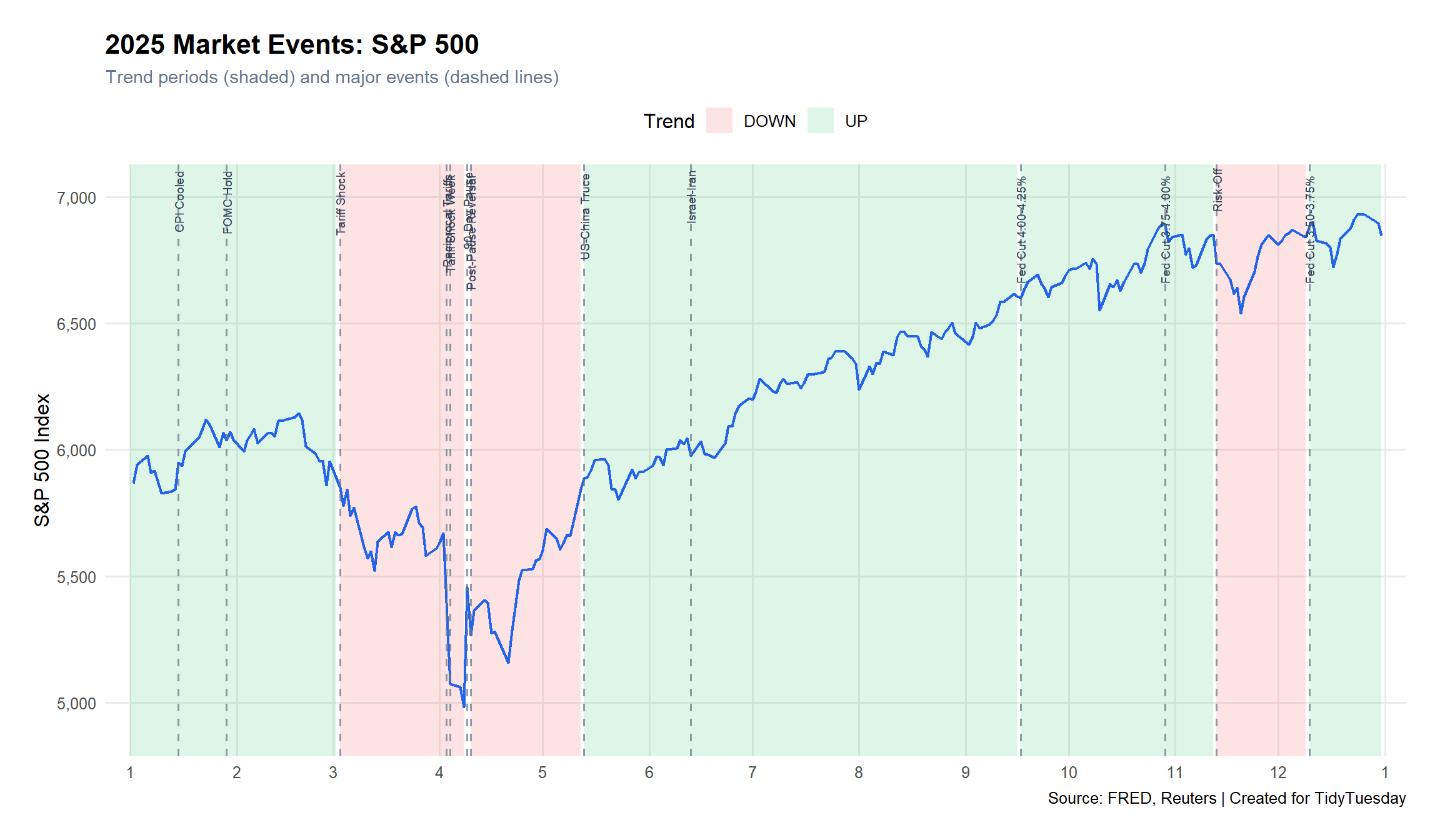
Event Impact Summary
# Bar chart of event impacts
events %>%
  filter(!is.na(sp500_change)) %>%
  mutate(
    direction = ifelse(sp500_change > 0, "Positive", "Negative"),
    event_label = fct_reorder(event_label, sp500_change)
  ) %>%
  ggplot(aes(x = event_label, y = sp500_change, fill = direction)) +
  geom_col() +
  coord_flip() +
  scale_fill_manual(values = c("Positive" = "#22c55e", "Negative" = "#ef4444")) +
  labs(
    title = "S&P 500 Daily Change by Event",
    subtitle = "Impact of major 2025 market events",
    x = NULL,
    y = "Daily Change (%)",
    fill = NULL
  ) +
  theme_minimal() +
  theme(
    plot.title = element_text(face = "bold"),
    legend.position = "none"
  )
Key Findings
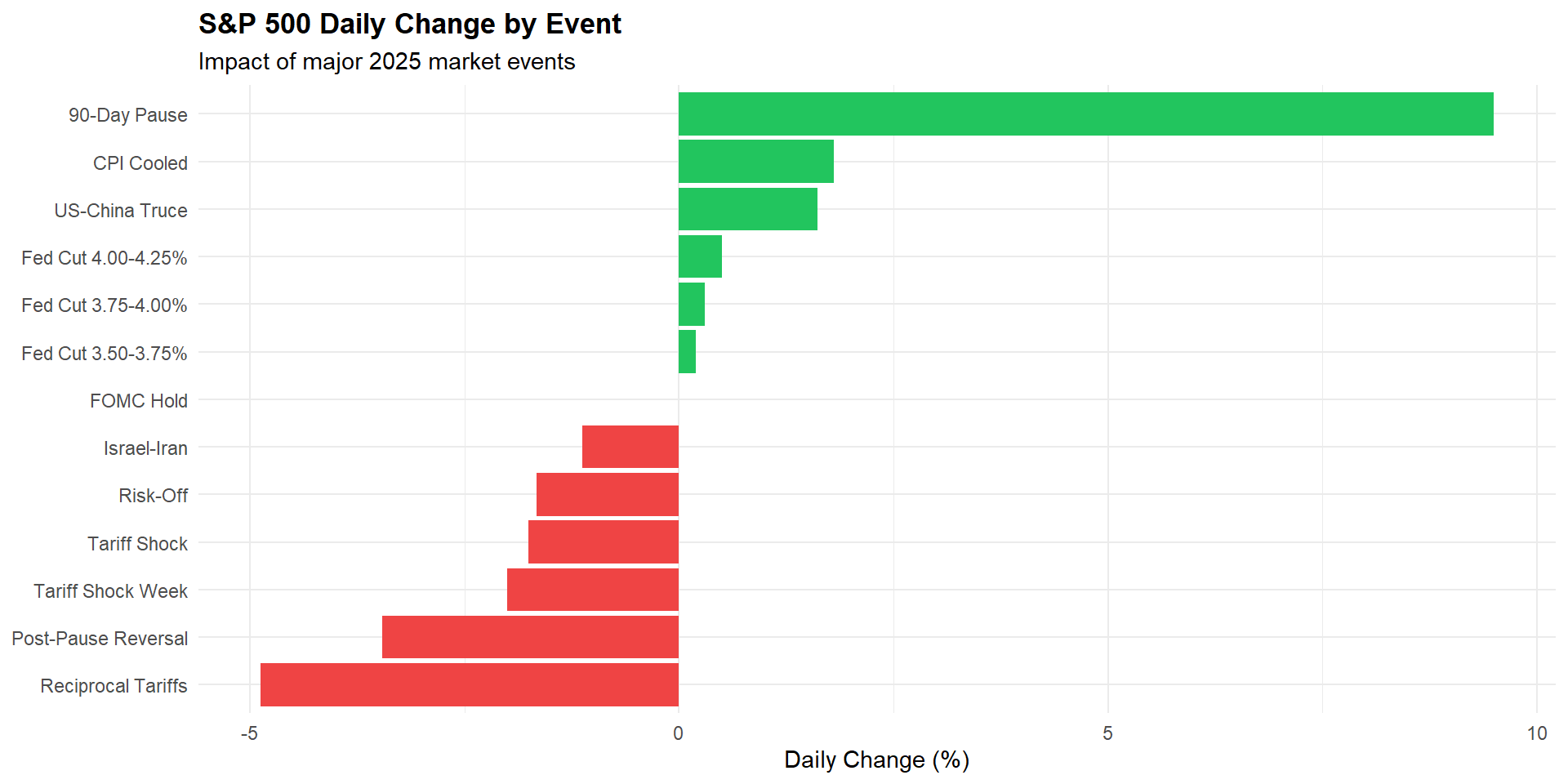
Tariff Shock (April 2025): The reciprocal tariffs announcement caused the largest single-day drop (-4.88%), followed by a historic +9.5% rally when the 90-day pause was announced.
Fed Easing Cycle: Three rate cuts (September, October, December) supported a gradual uptrend in the second half of 2025.
Geopolitical Events: The Israel-Iran escalation in June triggered a brief risk-off period with oil spiking +7%.
Trend Analysis: The year showed alternating patterns of sharp corrections followed by sustained rallies.
This post is part of the TidyTuesday weekly data visualization project.