Code
library(tidyverse)
library(scales)
library(glue)
library(patchwork)
library(ggtext)
library(ggrepel)
library(showtext)
library(colorspace)
library(janitor)
library(forcats)This week we explore seabird observations recorded under the Australasian Seabird Mapping Scheme: counts from ships during 10-minute periods near New Zealand waters. The data links bird records to ship position, weather, and season.
library(tidyverse)
library(scales)
library(glue)
library(patchwork)
library(ggtext)
library(ggrepel)
library(showtext)
library(colorspace)
library(janitor)
library(forcats)birds_path <- file.path(getwd(), "data", "birds.csv")
ships_path <- file.path(getwd(), "data", "ships.csv")
base_url <- "https://raw.githubusercontent.com/rfordatascience/tidytuesday/main/data/2026/2026-04-14"
if (!file.exists(birds_path)) {
birds_path <- paste0(base_url, "/birds.csv")
}
if (!file.exists(ships_path)) {
ships_path <- paste0(base_url, "/ships.csv")
}
birds <- readr::read_csv(birds_path, show_col_types = FALSE, na = c("", "NA"))Warning: One or more parsing issues, call `problems()` on your data frame for details,
e.g.:
dat <- vroom(...)
problems(dat)ships <- readr::read_csv(ships_path, show_col_types = FALSE)
birds_ship <- birds |>
inner_join(ships, by = "record_id") |>
mutate(
species_label = coalesce(species_scientific_name, species_common_name, "Unknown"),
count = replace_na(count, 0L)
) |>
filter(!is.na(species_label), species_label != "Unknown")
beaufort_path <- file.path(getwd(), "data", "beaufort_scale.csv")
if (!file.exists(beaufort_path)) {
beaufort_path <- paste0(base_url, "/beaufort_scale.csv")
}
beaufort <- readr::read_csv(beaufort_path, show_col_types = FALSE)NOTE_TEXT <- "Seabird logbook entries; counts may be censored at 99999 for very large flocks"
SOURCE_TEXT <- "TidyTuesday 2026-04-14 / Te Papa Tongarewa"
CAPTION <- glue("Note: {NOTE_TEXT} | Source: {SOURCE_TEXT} | \u00A9 2026 chokotto")
STYLE_MODE <- "figmamake"
theme_fm <- theme_minimal(base_size = 12) +
theme(
plot.background = element_rect(fill = "white", color = NA),
panel.background = element_rect(fill = "#f8fafc", color = NA),
panel.grid.major = element_line(color = "#e2e8f0", linewidth = 0.3),
panel.grid.minor = element_blank(),
text = element_text(color = "#334155"),
axis.text = element_text(color = "#475569"),
plot.title = element_text(color = "#1e293b", face = "bold", size = 14),
plot.subtitle = element_text(color = "#64748b", size = 10),
plot.caption = element_text(
face = "italic", color = "#94a3b8", size = 9,
hjust = 0, margin = margin(t = 12)
),
plot.caption.position = "plot",
strip.text = element_text(color = "#1e293b", face = "bold"),
legend.background = element_rect(fill = "white", color = NA),
legend.text = element_text(color = "#475569"),
plot.margin = margin(15, 15, 15, 15)
)
theme_active <- theme_fm
COL_PRIMARY <- "#0ea5e9"
COL_SECONDARY <- "#f59e0b"
COL_ALERT <- "#ef4444"
COL_POSITIVE <- "#10b981"
COL_BASE <- "#94a3b8"species_tot <- birds_ship |>
group_by(species_label) |>
summarise(total_count = sum(count, na.rm = TRUE), n_obs = n(), .groups = "drop") |>
filter(total_count > 0) |>
slice_max(total_count, n = 15) |>
mutate(species_label = fct_reorder(species_label, total_count))
ggplot(species_tot, aes(x = total_count, y = species_label)) +
geom_col(fill = COL_PRIMARY, width = 0.7, alpha = 0.85) +
geom_text(
aes(label = comma(total_count)),
hjust = -0.1, size = 3, color = "#475569"
) +
scale_x_continuous(labels = comma_format(), expand = expansion(mult = c(0, 0.12))) +
labs(
title = "Top seabird taxa by summed count in the survey window",
subtitle = "15 species with highest total birds recorded (all observations combined)",
x = "Total birds counted",
y = NULL,
caption = CAPTION
) +
theme_active +
theme(panel.grid.major.y = element_blank())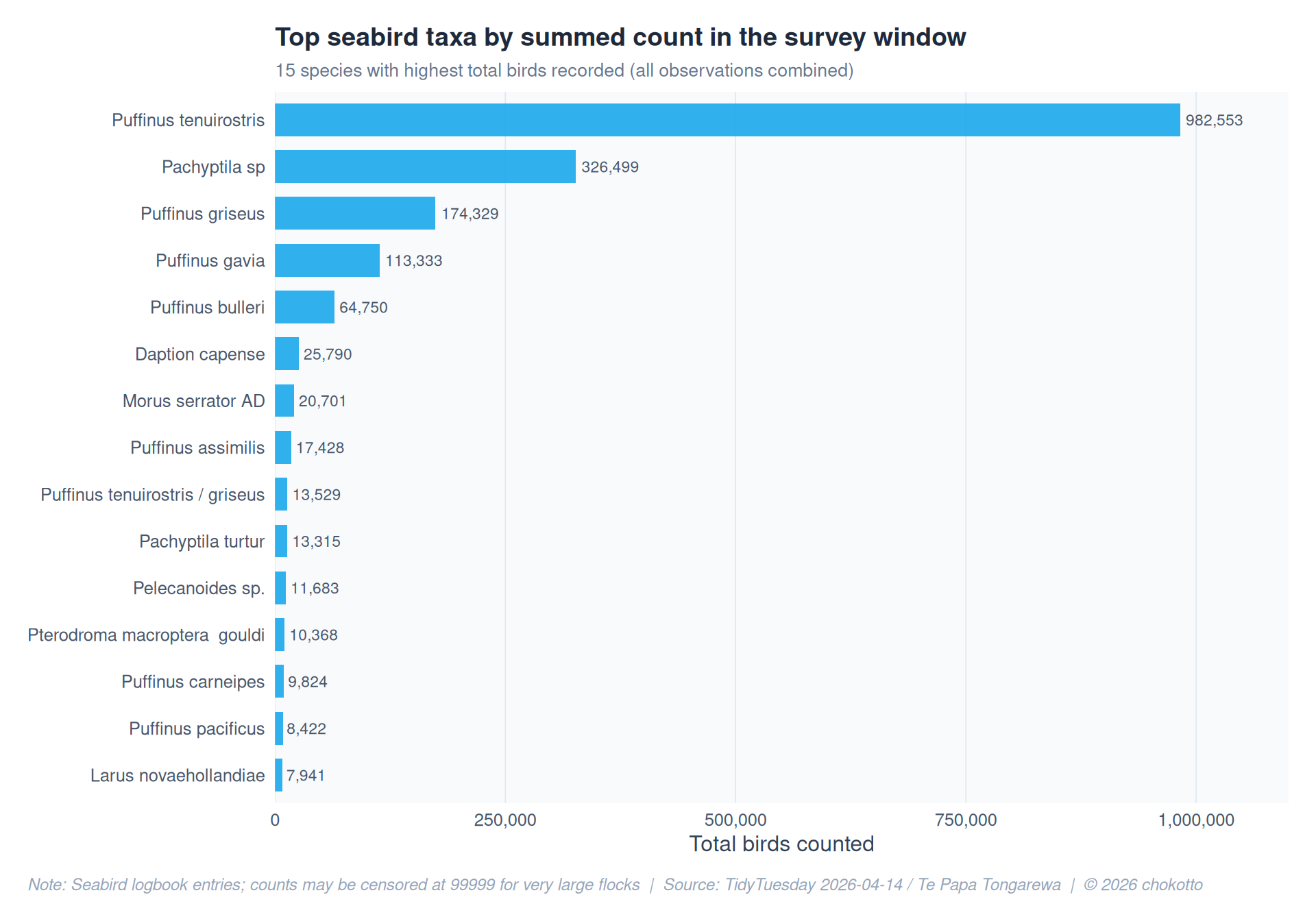
season_n <- birds_ship |>
  filter(!is.na(season)) |>
  count(season, name = "n_records")

ggplot(season_n, aes(x = season, y = n_records, fill = season)) +
  geom_col(width = 0.65, show.legend = FALSE) +
  scale_fill_manual(
    values = c(
      "summer" = COL_PRIMARY,
      "autumn" = COL_SECONDARY,
      "winter" = lighten(COL_ALERT, 0.2),
      "spring" = COL_POSITIVE
    )
  ) +
  scale_y_continuous(labels = comma_format()) +
  labs(
    title = "Observation records peak in southern summer",
    subtitle = "Number of bird records linked to ship logs by hemisphere season",
    x = NULL,
    y = "Number of records",
    caption = CAPTION
  ) +
  theme_active +
  theme(panel.grid.major.x = element_blank())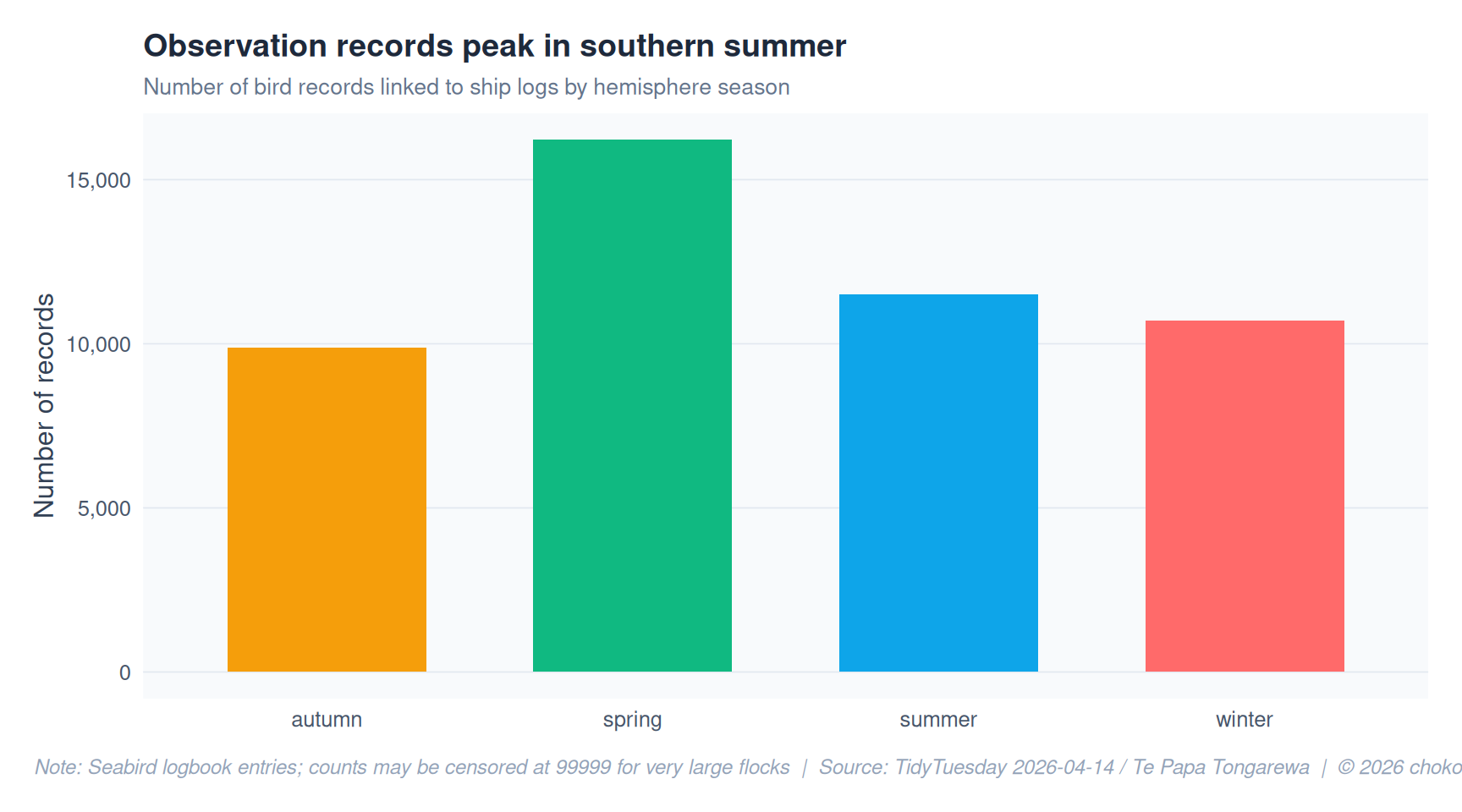
wind_df <- birds_ship |>
  filter(!is.na(wind_speed_class)) |>
  group_by(wind_speed_class) |>
  summarise(
    mean_count = mean(count, na.rm = TRUE),
    n = n(),
    .groups = "drop"
  ) |>
  left_join(
    beaufort |> select(wind_speed_class, wind_description),
    by = "wind_speed_class"
  )

ggplot(wind_df, aes(x = factor(wind_speed_class), y = mean_count)) +
  geom_col(fill = lighten(COL_SECONDARY, 0.25), width = 0.65) +
  geom_text(
    aes(label = comma(round(mean_count, 1))),
    vjust = -0.4, size = 3, color = "#475569"
  ) +
  labs(
    title = "Mean flock size by Beaufort wind class",
    subtitle = "Higher classes are rougher seas; counts remain substantial across conditions",
    x = "Beaufort wind class",
    y = "Mean birds per observation",
    caption = CAPTION
  ) +
  theme_active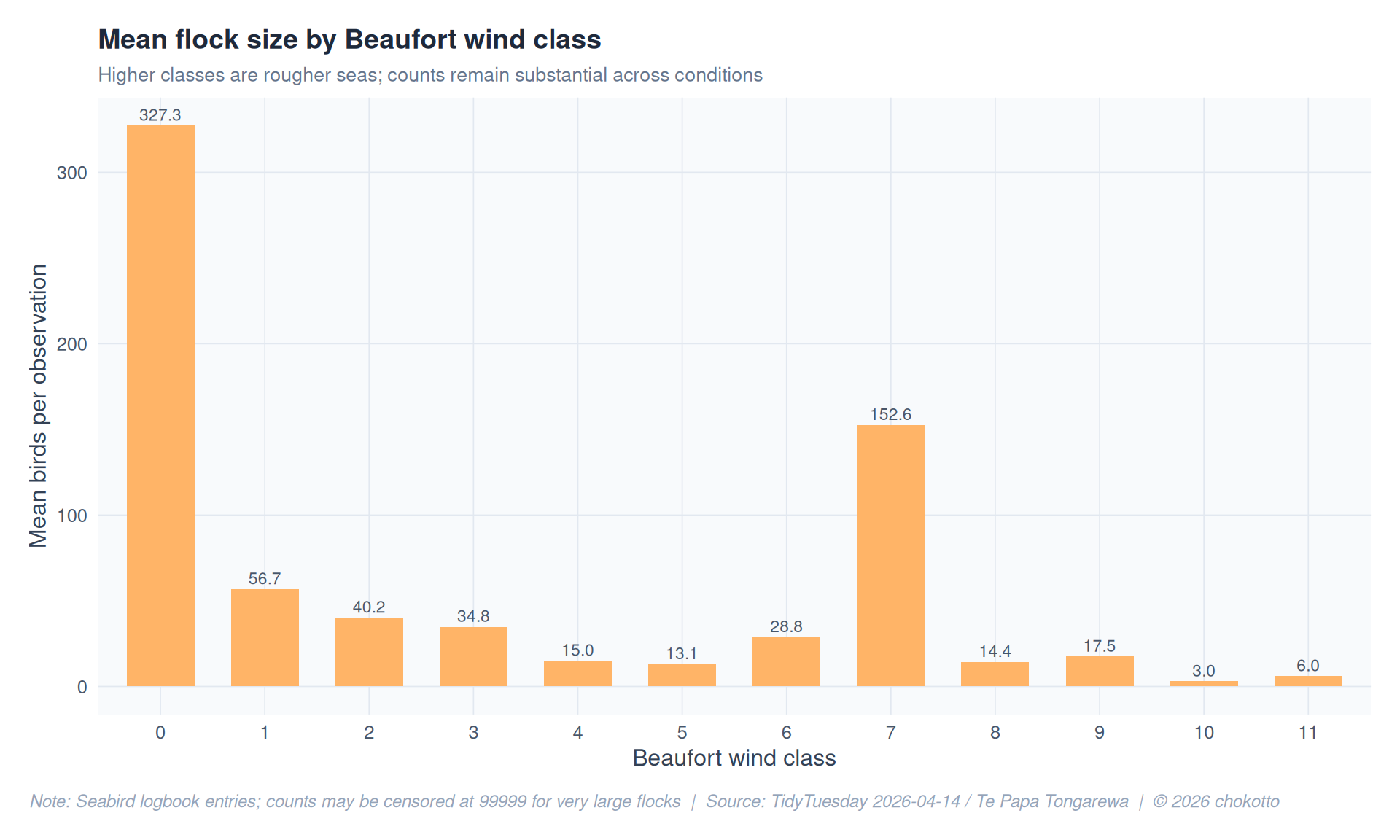
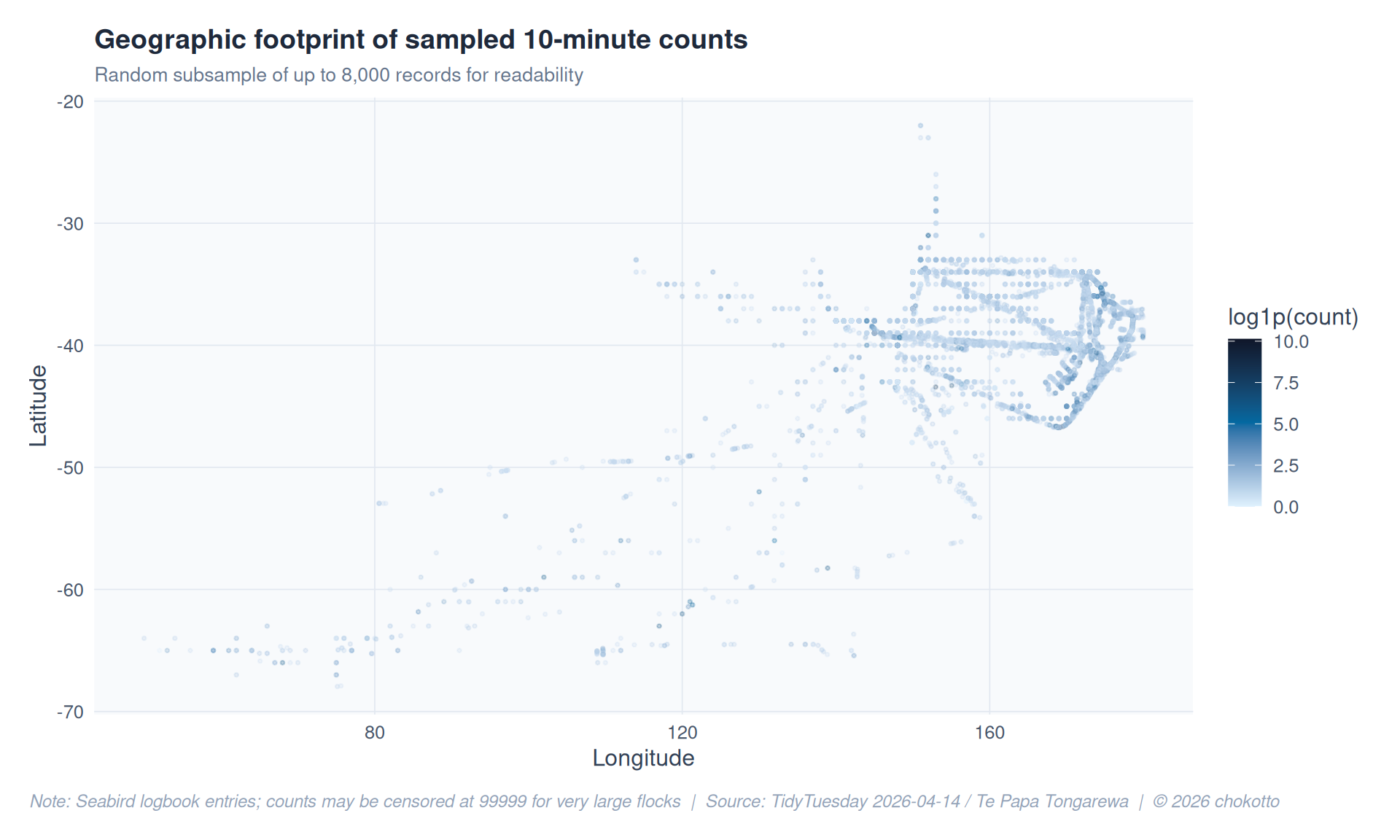
set.seed(42)
map_df <- birds_ship |>
  filter(!is.na(latitude), !is.na(longitude))

# slice_sample(n = min(8000, n())) fails: inside slice_sample(), n() is not nrow(.)
if (nrow(map_df) > 0L) {
  n_map <- min(8000L, nrow(map_df))
  map_df <- slice_sample(map_df, n = n_map)
}

if (nrow(map_df) == 0L) {
  ggplot() +
    annotate(
      "text", x = 0.5, y = 0.5, size = 4, color = "#64748b",
      label = "No latitude/longitude available for mapping."
    ) +
    theme_void()
} else {
  ggplot(map_df, aes(x = longitude, y = latitude)) +
    geom_point(aes(color = log1p(count)), alpha = 0.25, size = 0.6) +
    scale_color_gradientn(
      colors = c("#e0f2fe", "#0369a1", "#0f172a"),
      name = "log1p(count)"
    ) +
    labs(
      title = "Geographic footprint of sampled 10-minute counts",
      subtitle = "Random subsample of up to 8,000 records for readability",
      x = "Longitude",
      y = "Latitude",
      caption = CAPTION
    ) +
    theme_active +
    theme(legend.position = "right")
}
This post is part of the TidyTuesday weekly data visualization project.